Virtualization in the Age of AI: The Hypervisor Gets a New Job
Customers are angry about licensing, and a new tenant has arrived that nobody sized for: the autonomous AI agent. The hypervisor's job is changing from packing servers to containing, governing and proving what runs on them.
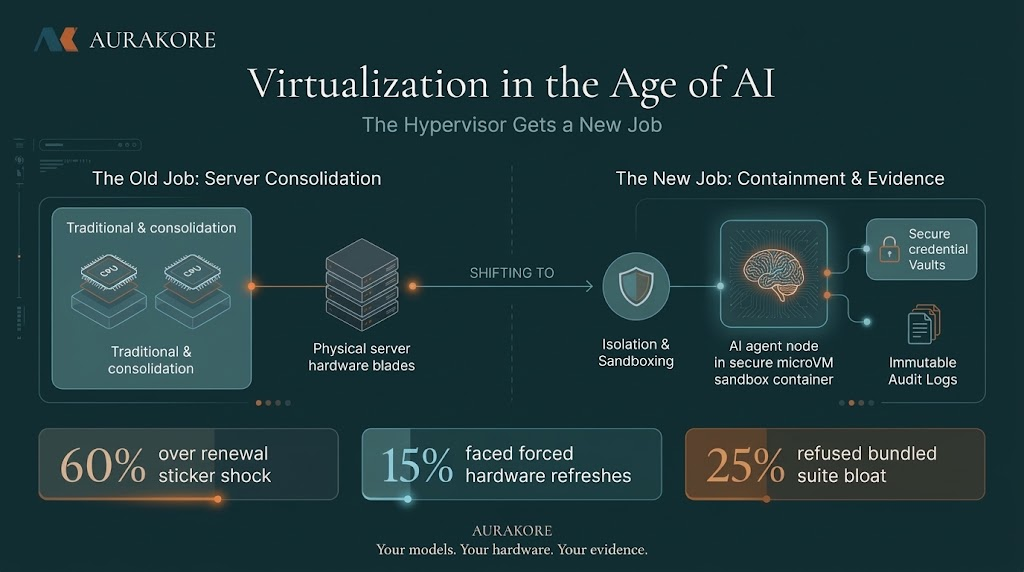
For twenty years, virtualization had one job: pack more workloads onto fewer servers. That job is done. Three years after Broadcom closed its VMware acquisition, the industry is arguing about what virtualization is for now, and a new kind of workload is arriving that nobody sized for: the AI agent.
Here is what the market is complaining about, what agents change, and where I think this goes.
What people are actually complaining about
What we hear firsthand. Aurakore runs a third-party VMware support practice, and our customers tell a consistent story. 60% came to us because of price. Another 15% faced a forced infrastructure upgrade before their planned due date, which meant unplanned cost. The remaining 25% run various vSphere licenses and refuse to pay for bundled suite bloat. Across all of them, the common thread was a lack of real support: they wanted experienced engineers on the other end of the ticket, not a queue. Our support engineers each have at least six years of VMware experience and are VCF certified.
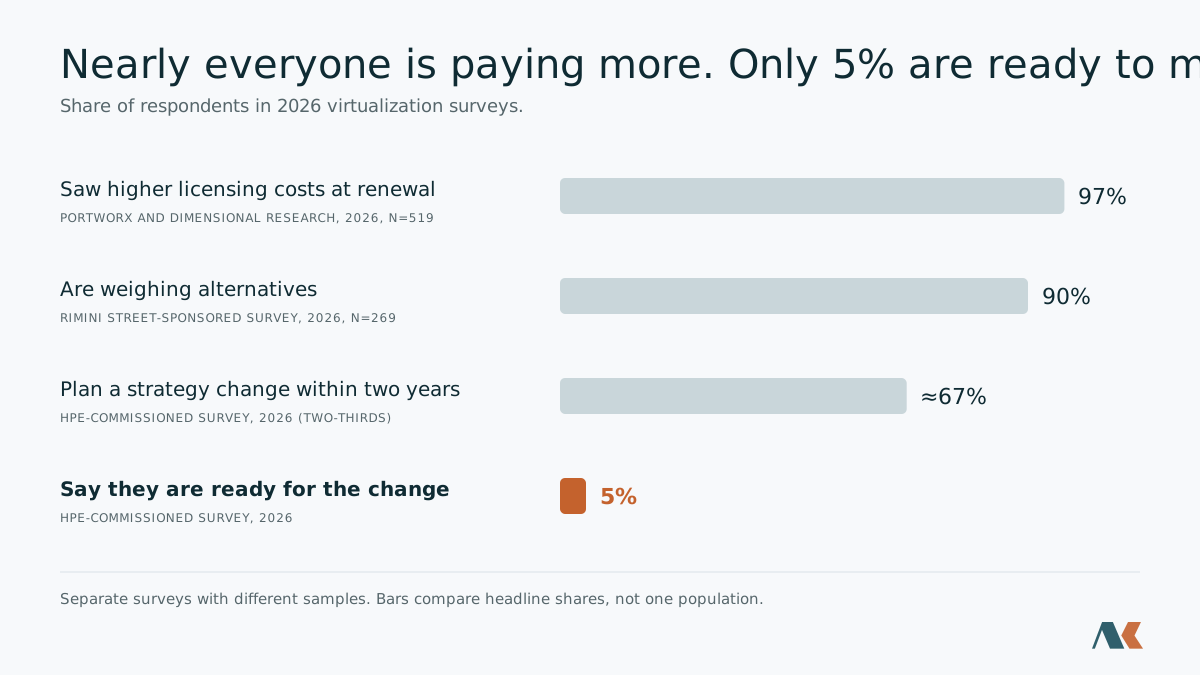
Price, first and loudest. A 2026 survey of 519 VMware-responsible professionals by Portworx and Dimensional Research found that 97% saw higher licensing costs at renewal. The European cloud association CISPE has reported member increases of 800% to 1,500%. In an October 2024 email to Broadcom's CEO, AT&T projected a roughly 1,050% rise in its VMware costs; that was AT&T's own projection, not a confirmed bill. Rival Nutanix says roughly 30,000 customers have already moved to it, though that is a competitor's claim.
Bundling. Customers who once bought individual components now buy complete suites, paying for capabilities they did not ask for.
An ecosystem in upheaval. Broadcom ended its cloud service provider program in January 2026, leaving many European providers outside it, and perpetual-license holders can no longer renew support. A Rimini Street-sponsored survey of 269 users found that 90% are weighing alternatives and 18% already use third-party support. (The sponsor sells third-party support, so read it with that in mind.)
Leaving is harder than wanting to leave. HPE's research found that two-thirds of IT decision-makers plan to rework their virtualization strategy within two years, yet only 5% say they are ready, and more than half still run VMware as their primary platform. Analysts quoted by Computerwoche describe migration as a multi-year program, not a procurement swap: architecture redesign, security validation, compliance recertification, retraining. Gartner expects about 70% of enterprise VMware customers to move at least half their virtual workloads by 2028.
The pattern is consistent: customers are angry, many are trapped, and almost all are in the middle of a slow, expensive decision.
Then AI changes the question
The cost conversation is only half the story. The other half is that AI workloads do not behave like the workloads hypervisors were designed around.
One IT services CTO told CIO magazine that AI is GPU-heavy and unpredictable, which breaks the old habit of sizing a VM once and leaving it alone. Hypervisors were built around steady, CPU-centric demand; AI is memory-hungry, GPU-bound and latency-sensitive. Some teams now ask whether they need full virtualization for these workloads at all.
And AI is shaping the buying decision itself. Omdia data cited by TechTarget shows that 73% of organizations judge a VMware alternative on how well it handles AI workloads, and that security ranks above cost when they choose.
The new tenant: the agent
An agent is not a chatbot. It reads files, runs commands, calls tools and acts with credentials. Docker's engineering community put the problem plainly in May 2026: agents are non-deterministic, prone to hallucination and prompt injection, and once they have write access, nothing stops a destructive command except the boundary around them.
So what is that boundary? The sandboxing debate keeps landing in the same place:
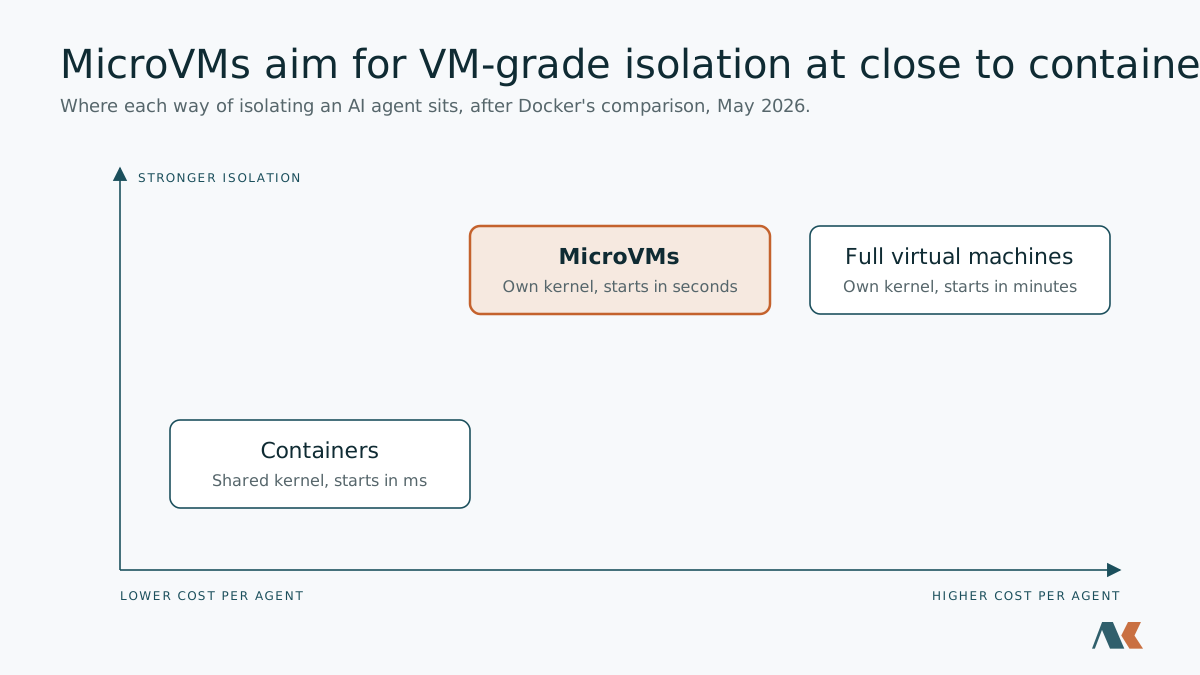
- Containers are convenient but share a kernel, and agents that need to build and run their own containers push teams toward privileged modes that weaken isolation.
- Full virtual machines give the strongest isolation, but the overhead is heavy when you run dozens of agents.
- MicroVMs try to deliver VM-grade isolation at container-like speed, and that is the direction Docker's sandboxes took.
It is not just Docker. Open projects such as stereOS and BoxLite also give each agent its own VM, arguing that hardware-level isolation matters when the agent holds real access.
The oldest idea in infrastructure, a boundary enforced by a hypervisor, is being rediscovered as the safety layer for autonomous software.
Broadcom sees it too. At VMware Explore 2026, it pitched VMware Cloud Foundation as the home for private AI, with agents treated as untrusted by default: sandboxes with no outbound access until it is granted, a credential store kept outside the sandbox so an agent never holds a secret, a product called AgentMinder for agent identity and policy, and network controls that discover and block unauthorized MCP tools.
Omdia's analyst offered a useful caution: nearly every new AI capability arrives as a separately licensed add-on on top of the platform customers already pay for, and the lines between the overlapping governance layers are not clearly drawn.
Where I think this goes
1. The boundary becomes the product. As agents multiply, the question "what can this workload touch?" matters more than "how many can I pack on a host?" Isolation, network policy and credential handling move from a checklist item to the core of the platform.
2. Governance cannot be a lock-in layer. The buyers who are leaving a vendor over licensing are not going to re-enter that same dependency through the agent layer. Controls that work across platforms, with portable policy and portable evidence, will beat controls that only exist inside one stack.
3. Private and sovereign wins on trust, if the economics hold. Broadcom's own research says 56% of enterprises are running or planning production inference in private clouds, and the Portworx report names data sovereignty as a main driver of change. Private only wins if the GPUs stay busy and the organization can prove what its agents did.
4. Evidence is the real currency. When an agent acts, the question regulators and auditors will ask is not "was it secure?" but "show me." Platforms that produce tamper-evident records of what ran, what it touched and what policy allowed it will have an edge over those that merely promise security.
What this means for infrastructure teams
If you are mid-decision on virtualization, resist treating AI as a separate project. Ask your next platform three questions: how does it isolate an autonomous workload, who holds the credentials, and where does the audit trail live and who owns it?
Virtualization is not dying. Its job description is changing: from packing servers efficiently to containing, governing and proving what runs on them, including software that makes its own decisions. That is the problem we are building toward at Aurakore, and I will share more soon.
Your models. Your hardware. Your evidence.
Sources
- Ars Technica, Nutanix claims 30,000 VMware customers, April 9, 2026
- Portworx and Dimensional Research, The Voice of Kubernetes Report 2026
- CloudMagazin, VMware cost trap 2026, citing CISPE and Gartner; the AT&T figure is from CIO Dive, October 1, 2024
- Channel Dive, Rimini Street survey of VMware users
- Computerwoche, VMware migration analysis
- CIO, Rethinking virtualization in the age of AI, February 19, 2026
- TechTarget and Omdia, VMware wants to become the enterprise home for AI agents, September 2, 2026
- Broadcom, VMware Private AI Cloud press release, August 31, 2026
- Channel Insider, Broadcom expands VCF for private AI, September 2, 2026
- Docker, Comparing sandboxing approaches for AI agents, May 7, 2026
- stereOS documentation
- BoxLite MCP
This post is about Aurakore Virtualization.
See Aurakore Virtualization