Inside Aurakore Legal Intelligence, grounded legal AI that also runs the firm
How Aurakore Legal Intelligence grounds every cited statement, reads later courts through its own citator, checks filings, reviews contracts and runs time, trust and billing for law firms.
Legal AI has one job it cannot fail at: never state something it cannot support. Legal Intelligence in Aurakore ERP is built around that rule, and around a second one: the AI proposes, and a lawyer decides.
It is built first for law firms of five to fifty lawyers, and it serves in-house legal teams as well. Everything below runs in production today; where something is not held or not yet available, we say so.
Contract review against your own playbook
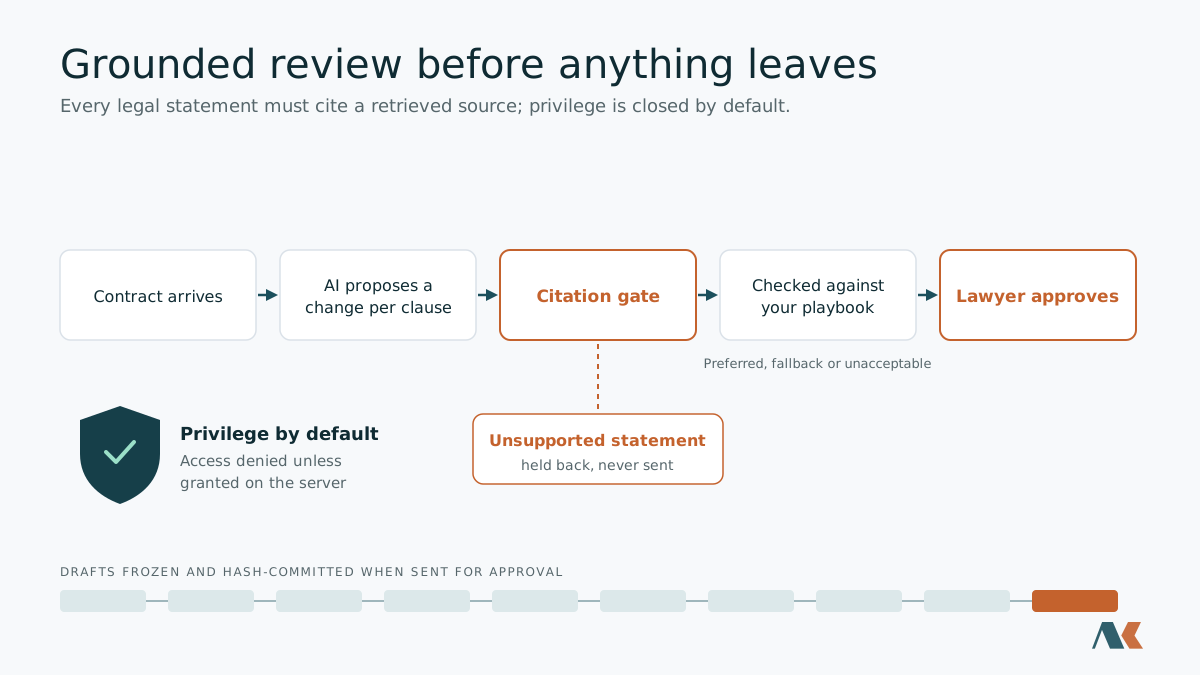
Upload a contract and the AI proposes a change clause by clause. Each clause is checked against your negotiation playbook, with a preferred position, fallback positions and an unacceptable position for each clause type, and you can swap in your standard wording with one click. A lawyer accepts or rejects every proposal. Redlines export to Word, and the result goes through approval before anything is final.
Your clause library holds playbook positions and your firm's own precedents, and you can insert from it in the drafting studio. The drafting studio produces 21 document types per jurisdiction, in English, French, German, Italian and Portuguese, drawing on the law with citations, your precedents and your playbook.
Grounded answers, and the controls behind them
- Every cited statement held to its source. Before an answer reaches a lawyer, each citation is checked against the source it cites. A claim the source supports is confirmed; a claim another retrieved source supports is re-attributed to it; a claim nothing supports is withheld, and the answer ends with a plain line saying what happened to each. On our evaluation set, the check took the hallucination rate from 0.429 to 0.000 and citation faithfulness from 0.667 to 1.000.
- Privilege by default. Privileged material is read only under a privilege grant, and access is denied unless it is granted on the server.
- Frozen drafts. When a draft is sent for approval it is frozen and hash-committed, so what was approved is exactly what goes out.
- Quoted answers. Ask up to 12 questions across up to 40 documents in a portfolio table, and every answer cell carries a verbatim quote, checked against the document.
Research and authority
The corpus holds 3.73 million passages of primary law and case law, one section, article or decision per passage, each with its official link and date. It covers the United States (the Supreme Court since 1791, the federal courts of appeals and the appellate courts of nine states since 2018), Canada, France, Germany, Portugal, Italy, Brazil, the European Union, the United Kingdom and Australia. A coverage page, generated from the corpus itself, says per jurisdiction what is held and what is not: UK case law waits on a licence, Australian courts refuse reuse so none is held, and Italian case law is the Corte costituzionale only.
Aurakore's own citator is built from the open citation graph: 10.07 million decisions and 77.5 million citing links. For a decision, it shows who cited it, what it relied on, and what each later court did with it, read from that court's own passage. Only a court with the power to overrule is reported as changing the law. On fourteen labelled pairs, it read thirteen correctly, every express overruling among them.
Surveys ask one question of a set of jurisdictions and keep one cell per jurisdiction, answered only from that jurisdiction's own law. A jurisdiction the corpus does not hold never reaches the model. On the first live run, 37 of 48 labelled cells read as labelled, with a hallucination rate of 0.011; the other eleven said no source was found rather than answering from memory.
Litigation and filings
The filing check reads a brief, memo or filing and reports, citation by citation, whether the decision exists and the name matches, whether each quotation appears in the decision's own text, and whether the decision supports the proposition attributed to it. Overruled authority is flagged. The result is a certificate the signer can attach, written with rules like Texas's proposed Rule 13 in mind. The product never says a filing is correct: that representation belongs to the signer.
Brief analysis reads the arguments, not only the citations: the authority each argument rests on, the held decisions it does not cite, and findings of nine named kinds, each with its evidence. Read your own draft to see what to fix first, or the other side's to see what to attack first. On twelve labelled briefs it found 25 of 25 planted findings.
Complaint analysis reads a complaint into parties, causes, relief and a timeline, and each cause against the elements the forum's own appellate decisions state. An element the complaint pleads no fact to is reported, with the decision that names it. For the nine US states whose law is held it found 66 of 68 labelled items; for any other forum it says the law is not held and names nothing.
Running the firm, in the same system
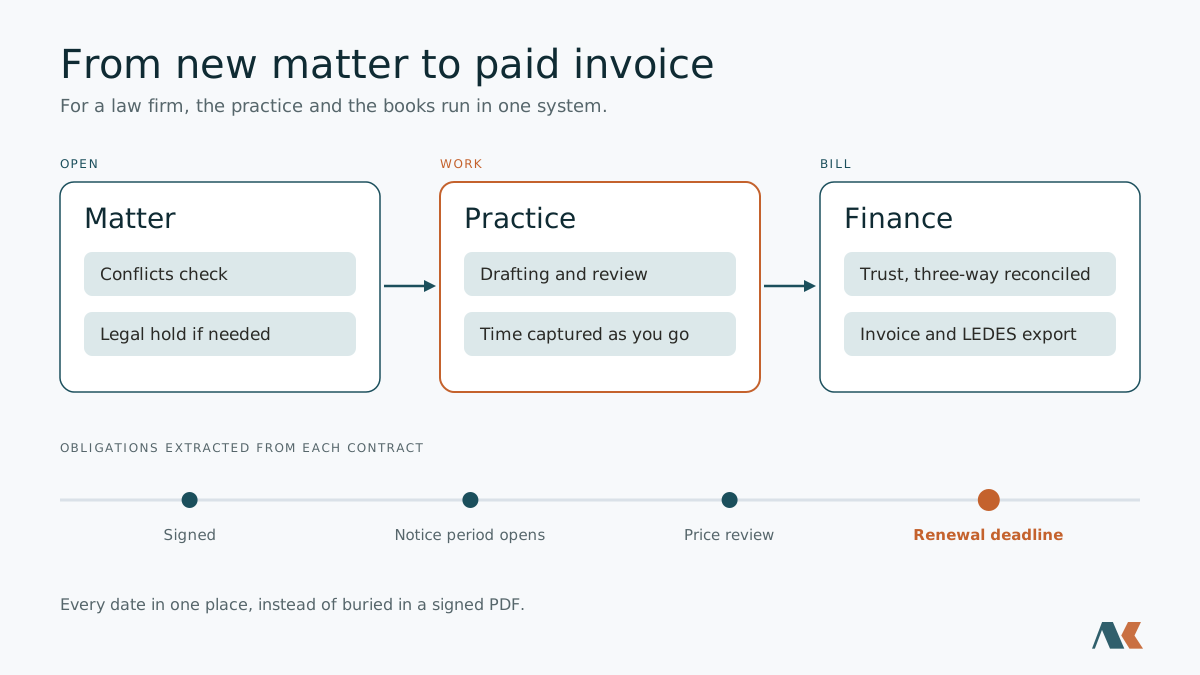
Because Legal Intelligence is a module of Aurakore ERP, the practice and the books are one system:
- Matters, with a conflicts check across every matter, contract, CRM record and entity when they open (a lawyer clears it, never the AI), and legal holds with custodian notices and acknowledgements
- Time capture, with a timer and time entries you can log from chat
- Trust accounting, where the ledger refuses what a bar refuses, three-way reconciliation needs a second signature, and rule sets for 24 jurisdictions across the US, Canada, England and Wales, Australia, France, Germany, Spain, Italy, Portugal, Brazil, Mexico and Argentina are held as data with their sources
- Billing into Finance invoices, with LEDES 1998B export
- Obligations extracted from each contract, so every date is in one place
- Practice packs for US personal injury, family and immigration work
- NDAs, e-signature, DSAR handling with due dates per regime (GDPR, UK GDPR, CCPA, PIPEDA and LGPD), and an entity registry
Why this beats a standalone legal AI or CLM
Against Harvey. Harvey is a strong AI platform for large firms and enterprise legal teams. It is not where a firm runs its business: conflicts, time, trust accounting and billing live in other systems, and pricing is by enterprise quote. Aurakore pairs grounded research, filing checks and contract work with the practice and the books, at a published price. More in Aurakore vs Harvey.
Against CoCounsel. CoCounsel leads on research content and editorial signals from Westlaw, and we say so. Aurakore holds its own corpus and citator, publishes what it does not hold, and carries everything after the research: the filing certificate, the matter, the time, the trust ledger and the invoice. More in Aurakore vs CoCounsel.
Against Ironclad. Ironclad is a contract lifecycle tool built for in-house teams and sold on an enterprise quote. It manages the contract, but the matter, the time and the money are elsewhere. In Aurakore, the contract, the obligations, the matter and the invoice are connected, and prices are published. More in Aurakore vs Ironclad.
Plans
Legal Intelligence is in the Premium plan, $109 per user per month billed annually, which includes all ten Aurakore ERP modules. AI is included with every seat.
This post is about Aurakore ERP.
Explore Aurakore ERP